What criticality means
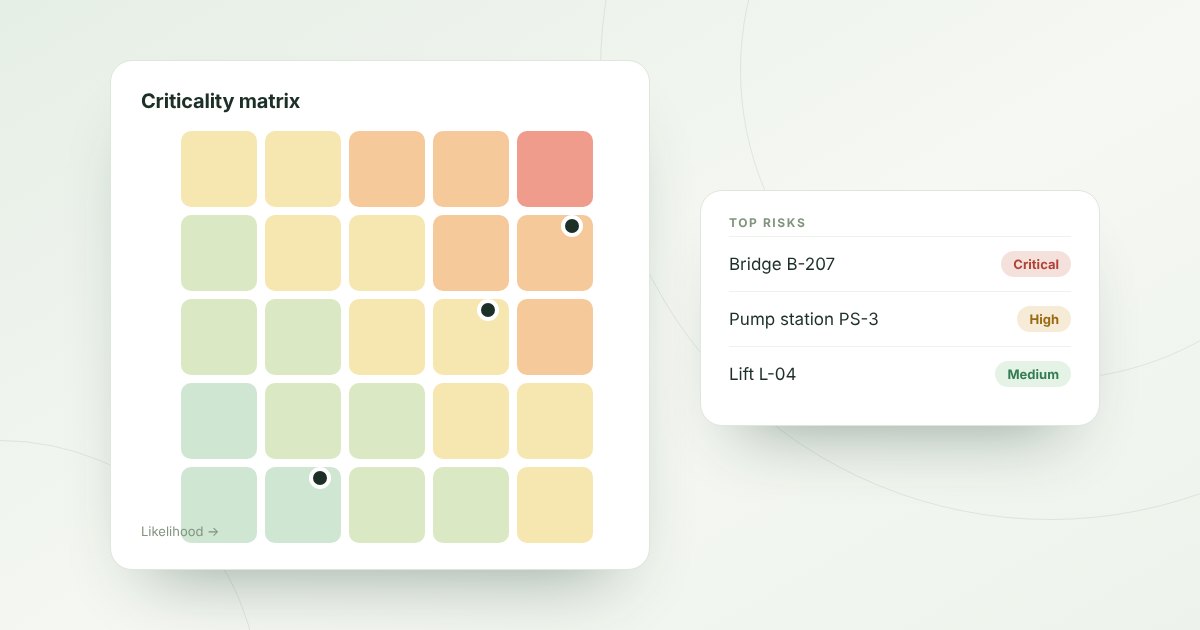
Criticality combines two things: how bad it is when an asset fails, and how likely it is to fail. A transformer that feeds a hospital and is showing its age is highly critical. A spare air conditioner in a store room is not.
Score the consequence
Use a short scale, for example 1 to 5, and score the consequence of failure on the things your organisation cares about.
- Safety: could someone be hurt?
- Service: how many people or how much production is affected?
- Cost: what does the failure and the repair cost?
- Compliance and reputation: will a regulator or the public notice?
Score the likelihood
Likelihood comes from condition, age and history. An asset in poor condition with repeated failures scores high. A new asset in good condition scores low. Inspection results and work order history are the best sources.
Combine and rank
- Multiply or use a matrix
Consequence times likelihood gives a score from 1 to 25.
- Group the results
For example: critical, high, medium and low.
- Check with the experts
Ask engineers and operators to review the top of the list. Their knowledge catches what the scores miss.
Use the ranking every day
- Maintenance: critical assets get condition monitoring and shorter intervals.
- Spare parts: keep spares on site for critical assets with long lead times.
- Work orders: faults on critical assets get the fastest response.
- Capital plans: critical assets in poor condition are replaced first.
Keep it current
Consequence changes slowly, but likelihood changes with every inspection. If condition data updates the score automatically, the ranking stays useful without a yearly workshop.
How Mintema helps
In Mintema, criticality and risk are fields on every asset. Approved inspections update condition, rules can recalculate the score, and dashboards show the riskiest assets by organisation and asset class, ready for the capital plan.