Why most registers fail
Registers rarely fail because of software. They fail because nobody owns them, because each department records assets its own way, and because the register is updated once during a project and then left alone. Within a year the field team keeps its own spreadsheet again, and finance keeps another.
A register you can trust has three qualities: it is complete enough for the decisions you need to make, it follows one set of rules across the organisation, and it is updated by the daily work itself, not by a separate clean-up exercise.
Start from the decisions, not the data
Before you list a single field, write down the decisions the register must support. For example: which assets need inspection this year, which ones cost the most to maintain, which ones should be replaced first. Each decision tells you which information you really need.
- Maintenance planning needs the asset type, location, criticality and maintenance history.
- Capital planning needs age, condition, expected life and replacement cost.
- Compliance needs certificates, inspection dates and the owner responsible.
Decide how deep to go
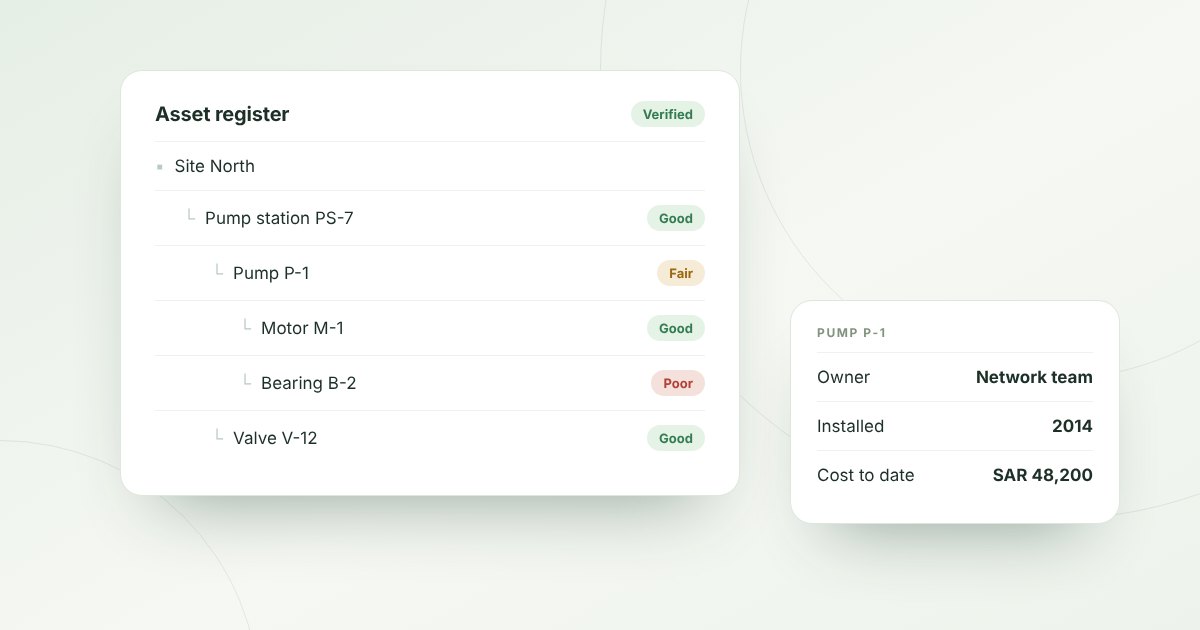
A pump station can be one asset or fifty. The right depth is the level at which you plan work, record failures and spend money. If you replace bearings and seals separately and want to know which fails most, those components belong in the register. If you only ever replace the whole unit, one record is enough.
Good platforms let you go deeper later without rebuilding the register. Start with the level your teams work at today, and add components where the data starts to matter.
Agree one set of rules
- Asset types
Define each type once, with its own fields, for example bridge, pump, lift or building.
- Naming and numbering
Use automatic codes so two teams never number the same asset differently.
- Locations
Use one location structure: site, building, floor, room, or route and segment.
- Ownership
Every asset belongs to one organisation and has a named owner.
Write the rules down in a short guide of two or three pages. Long standards documents are not read.
Load what you have, then improve it
Do not wait for perfect data. Import what exists, mark the records that need checking, and let the first round of inspections confirm or correct them. Field teams with a tablet will fix in weeks what a desk exercise takes months to do.
Keep it clean without a clean-up project
The register stays accurate when the daily work updates it. An approved inspection should change the asset’s condition. A closed work order should add its cost. A replaced part should create a new component record. When the register is the place where work happens, people stop keeping their own lists.
- Only allow condition to change through approved inspections.
- Post every cost from work orders to the asset automatically.
- Keep a full history of who changed what and when.
How Mintema helps
Mintema gives you one register for every asset class, with unlimited component depth, asset types designed in the No-Code Studio, automatic numbering and a full audit trail. Inspections, work orders and sensors all update the same record, so the register stays current on its own.